The Astrology Center of America, 207 Victory Lane, Bel Air, MD 21014
Tel: 410-638-7761; Fax:410-638-5154; Toll-free (orders only): 800-475-2272
Home Author Index Title Index Subject Index Vedic Books Tarot E-Mail: Dave


Ancient, Traditional Astrology


Ancient astrology is the Greco-Roman stuff, and more recent authors inspired by them. It is earlier, and different, from Medieval.

Indicates a book on our Top Ten list. If you would like to find more books like it, click on the star.

MATHESEOS LIBRI VIII - Ancient Astrology Theory & Practice - Firmicus Maternus, translated by Jean Rhys Bram, $29.95
Contents:
Book 1: Opening letter, arguments, difficulties, refutations, conclusions.
Book 2: Introduction, signs, domiciles, exaltations, falls, decans, degrees, diurnal/nocturnal sects, matutine & vespertine, rising times, signs & winds, dodecatemoria, life cycles, houses, angles, aspects, human body, length of life, chronocrators, antiscia, etc.
Book 3: Planets in houses, Mercury/planet conjunctions, moon in houses, moon with Part of Fortune.
Book 4: Moon applying to planets, moon void of course, moon translating light from planets, Parts of Fortune & Spirit, Lord of the geniture, climacteric years, vocational indicator, full & void degrees in decans, masculine & feminine degrees, angular lunar conjunctions, etc.
Book 5: Angles by sign, ascendant by terms & conjoined planets, Saturn & Jupiter by sign, Mercury & Moon by terms or decans, advice on interpretation.
Book 6: Bright stars, planets in trine, square, opposition & conjunction, lunar configurations before birth, unfortunate nativities, sexual proclivities, planets as chronocrators, etc.
Book 7: Astrologer's oath, exposed infants, twins, monstrous births, infirmities, parental death, orphans, number of marriages, homosexuality, murder of spouse, infertility & celibacy, royal genitures, violent death, criminal nativities, eunuchs, hermaphrodites & perverts, occupations, etc.
Book 8: Astrologer's creed, Enenecontameris (90th degree), beholding & hearing signs, degrees in zodiacal constellations, extra-zodiacal constellations, the Myrogenesis (degrees of the zodiac), bright stars, advice on interpretation, conclusion.

Appendices: Translator's notes, Index of occupations, List of ancient astrologers, Bibliography, Glossary, Index.

Comment: Julius Firmicus Maternus, a native of Sicily, was a Roman lawyer of the senatorial class. He lived from c.280 to c.360. He was also a student of Greek astrology, which forms the basis of this book. James Holden writes, The Mathesis is the lengthiest astrological treatise that has come down to us from the classical period. It consists of 8 books, of which the first forms an introductory essay on astrology and the rest set forth the fundamentals of Greek astrology. Several sections contain material that is found nowhere else.

One of the classic books, studied by astrologers for more than a thousand years. This is also one of the best-translated books we have seen. The English is modern, clear & direct.

A reader raised a question about the list of full & empty degrees, given on pgs. 148-150. To clarify: For each sign, there are six locus. For Aries, the first locus has three degrees & they are empty. The second locus has five degrees, and they are full. The third has 9 degrees, empty, the fourth has four degrees, full, the fifth has five degrees, empty, and the sixth & last has four degrees, and is full. Checking the other signs, Cancer has 31 degrees, and a seventh locus (of 1 degree), which appears to be a mistake. As the total of empty Cancer degrees totals 12 (one more than it should have), we may presumably delete the last Cancer locus. Total of full & empty degrees in Libra also totals 31, which is the number of degrees the text says it should have (a zodiac of 361 degrees, presumably). (I would like to hear a solution for that.)

Click here for an extract (PDF).

Astrology Classics, 338 pages.


CARMEN ASTROLOGICUM - Dorotheus of Sidon, translated by David Pingree, $21.95
Contents: Preface

The first book of Dorotheus: On the upbringing and condition of the native
1. The knowledge of the seven in longitude and latitude, and the triplicities of the signs and their lords; 2. The exaltation of the planets; 3. Judgment about the case of the native or his difficulty to his mother; 4. Judgment concerning the matter of the upbringing of the native; 5. On the superiority of the places; 6. The power of the seven planets; 7. The upbringing of natives, and for whom there will be an upbringing or for whom an upbringing will not be known; 8. Knowledge of the masculine and feminine “hours” of the nativity; 9. The matter of bringing up again; 10. Knowledge of what indicates whether the native and his mother are slaves or free;

11. The knowledge of how many will own the native if he is a slave; 12. Consideration concerning the upbringing of the native, his condition, and his livelihood; 13. Knowledge of the lot of the father; 14. The lot of the mother; 15. Knowledge of the death of the parents of the native, one of the two before his companion; 16. Knowledge of whether the native will inherit his parents’ property or not; 17. Knowledge of how many will be born to the mother of the native; 18. On the matter of brothers; 19. The lot of brothers; 20. Knowledge of the love of the brothers;

21. Knowledge of the number of brothers and sisters; 22. Knowledge of the matter of the fortune of the native and [his] property and his illness; 23. Knowledge of the division of the planets with regard to good and evil; 24. In it are judgments concerning the matter of fortune and property in nativities; 25. On the knowledge of the excellence of fortune; 26. The magnitude of fortune and property; 27. The decline of status and disaster; 28. Knowledge of masculine and feminine signs, eastern and western, and diurnal and nocturnal.

The second book of Dorotheus: On marriage and children
1. “The beginning of its beginning is from marriage"; 2. Knowledge of the lot of wedding; 3. Knowledge of the lot [in] the nativity of a woman; 4. The lot of marriage; 5. Knowledge of how many wives he will marry; 6. Knowledge of the lot of wedding by day and by night; 7. Knowledge of sodomy; 8. Exposition of the matter of children; 9. Knowledge of the number of children; 10. Knowledge of the lot of children;

11. Lot of transit with respect to children; 12. Knowledge of females and males; 13. Knowledge of whether females or males are more numerous; 14. Aspect of trines, if one of the planets aspects another from trine; 15. Quartile [aspect]; 16. On the planets’ aspect from opposition; 17. Aspect of the planets from sextile; 18. If Saturn is with one of the seven; 19. If Jupiter is with one of the seven; 20. Knowledge of the places of the planets;

21. Arrival of the Moon in the places; 22. Arrival of the Sun in the places; 23. Arrival of Saturn in the places; 24. Arrival of Jupiter in the places; 25. Arrival of Mars in the places; 26. Arrival of Venus in the places; 27. Arrival of Mercury in the places; 28. Arrival of Saturn in another’s house; 29. Arrival of Jupiter in another’s house; 30. Arrival of Mars in another’s house; 31. Arrival of Venus in another’s house; 32. Arrival of Mercury in another’s house; 33. On the arrival of the planets, one of them in the house of another.

THE THIRD BOOK OF DOROTHEUS WHICH HE WROTE WITH RESPECT TO THE HAYLAJ AND THE KADHKHUDAH, WHICH ARE THE GOVERNOR AND THE INDICATOR OF THE TIME OF THE YEARS OF LIFE.
1. Governors and indicators of the years of life; 2. The haylaj.

THE FOURTH BOOK OF DOROTHEUS ON THE TRANSFER OF YEARS. 1. The transfer of years.

THE FIFTH BOOK OF DOROTHEUS, ON INTERROGATIONS.
1. “Introduction"; 2. Judgement according to the crooked and the straight; 3. Judgement according to the tropical [signs]; 4. Judgement according to the twin [signs]; 5. The corruption of the Moon; 6. One who wishes to build a building; 7. If you wish to demolish a building; 8. “Hiring and letting out"; 9. Buying and selling; 10. The buying of land;

11. The buying of slaves; 12. The buying of animals; 13. If you want to free a slave; 14. If you want to ask from a ruler or from a man for a request or a gift or other than this; 15. If you want to write to a man or you want to teach a man a science or writing; 16. Marriage and matrimony; 17. The courtship of a woman, and what occurs between a wife and her husband when she quarrels and scolds and departs from her house publicly; 18. A pregnant woman, if her child will die in her belly; 19. Partnership; 20. Debt and the payment for it;

21. The journey; 22. Departure from a journey; 23. Buying a ship or building it; 24. Commencing to build a ship; 25. Commencing to row the ship in the water; 26. “If a book or a message or a letter"; 27. Bondage and chains; 28. Judgement about what may not be afterwards of a matter which one hopes for, or according to this of things; 29. Query about the sick; 30. The commencement of all things;

31. “To know the condition of a sick [man]"; 32. “To know when the property of the native will increase or decrease"; 33. Clarification of the matter of two adversaries, if they argue and plead before a judge, which of the two will be successful and which of the two will be defeated; 34. “Concerning whether whether a man will depart from his land"; 35. If you want to know the matter of a theft that has been committed or something that has been lost, whether he will possess it [again] or not; 36. The runaway; 37. The treatment of spirits; 38. Someone wishes to retain [his food] or to drink a medicine for diarrhoea, and the rest of what is a remedy, with which he is cured from vomiting and diarrhoea; 39. Someone wishes to cut something from his body with a knife or scalpel, or to bleed a vein; 40. If there is an infection in the eye or a covering over it or something of what is treated with iron;

41. Illness as Qitrinus the Sadwali says; 42. The will; 43. On clarifying the phases [fasis] of the Moon and the head of the dragon and its tail, which indicate selling and buying and cheapness and expensiveness.

Appendix 1: Charts in modern format; Appendix 2: Table of dignities; Appendix 3: Dodecatemoria; Index

Comment: Dorotheus of Sidon, who appears to have lived in Alexandria, flourished in the first century AD. He wrote his Pentateuch (five books) on astrology in Greek, in verse. This translation, from 1976 by David Pingree, is from a fourth century Pahlavi (Persian) source.

The first book is on the judgement of nativities. Book two concerns marriage and children. Book three is on the length of life. Book four is on the transfer of years, i.e., forecasting. Book five is on interrogations, i.e., electional astrology.

In this book are the earliest known astrological charts. Dorotheus bases much of his interpretative methods on the triplicity rulers, by day and by night. All fire signs have the same rulers. All earth signs have their rulers, as do air and water signs. He uses Egyptian terms. He, like the Greeks of his day, also uses the Dodecatemoria, which are the twelfths of a sign. And many, many lots, all defined.

For the first time in this edition: Pingree's Preface newly translated. An appendix with charts in modern format. A complete table of terms and triplicity rulers. A table to calculate Dodecatemoria. Newly reset to match Pingree's original 1976 edition.

Written a century before Ptolemy, here is the mainstream of Greek astrology. It will handsomely repay study. Click here for a pdf extract, which happens to include seven of the nine charts in the book.

Astrology Classics, 192 pages.


THE BOOK OF INSTRUCTIONS IN THE ELEMENTS OF THE ART OF ASTROLOGY - Al Biruni, translated by R. Ramsay Wright, $12.95
Contents: The Signs: Nature, characteristics, related to compass & winds; Influence on character, figure, face, profession, disease, crops, animals; Years of signs; Signs & planets in aspect & inconjunct; Relations other than aspect; Ascending & descending; Triplicities & quadrants

Planets: Nature, characteristics, related to compass; Lords of the hours & days of week; Relation to climates & cities; Their years, periods (Firdaria) of control of human life; Tables for indications as to soils, buildings, countries, jewels, foods, drugs, animals, crops, parts of the body, disposition & manners, disease, professions, etc.; Orbs & years: details of Firdaria; Domiciles & detriments, exaltation & fall; As lords of triplicities; Aspects, friendship & enmity

Divisions of the signs: Halves, Faces, Paranatellonta, Decanates, Ptolemy's thirds; Terms & their lords; Ninths & twelfths; Characteristics of degrees of the signs

The Houses: Tables of indications at nativities, at horary questions, as to organs, powers, joys & powers of the planets; Sex; Characteristics of of groups of houses in threes & sixes

The Part of Fortune: Tables of other Lots cast in a similar way; Relative position of planets & sun; Gazimi; Orientality; Influence changed under certain conditions; Tables; Application & separation; Dead degrees; Conjunction in longitude & latitude; Dignities; Order of precedence; Favorable & unfavorable situations of planets in signs & houses; Interference with their conjunctions; Reception, etc.; Substitute for conjunction & aspect; Opening the doors; Strengths & weaknesses of planets; The Combust Way

Judicial Astrology: Five divisions & astrological principles on which inquiries are based in each; Lord of the year; Determining conditions at a nativity, Hyleg, Ascendant, Horoscope, Direction or Aphesis, Gifts of length of life, Positon of the malefics which terminate it; Elections; Selecting suitable time for action; General questions; Thought reading; Danger of hasty conclusions; Index.

Comment: Written in Ghaznah in 1029 AD, this is a classic compilation of astrological rules & techniques. Much of the Greek-based material in the book is contrasted to Hindu astrology, which only reminds us that the Arab world was located between the Greek & the Indian. Among the highlights: Introduction to Firdaria, as well as ninths (navamsa) & 12ths (dodecatemoria) of signs. The largest listing of Arabic parts (Lots) ever, more than 150. Here they are organized by house, with secondary groups for planets, as well as mundane, crops & horary. The discussion of areas of the sky promoting blindness led to the surprising discovery that Arabic lunar mansions have shifted by two entire mansions over the past 1000 years. In other words, what used to be the 5th mansion is now the third. Notes on astrometeorology of the signs are further broken down by decanate & declination. Many other surprises in this book, I suspect. Completely reset (including tables), with index. Click here for a pdf extract.

Astrology Classics, about 100 pages.


ASTROLOGICAL ROOTS: THE HELLENISTIC LEGACY - Joseph Crane, $42.00

Contents:

Chart data
Preface
Introduction

1. Astrology's bricks & mortar
2. Astrology's planets
3. Kinship of planets & the zodiac
4. Triplicites
5. Planetary lords & determination of soul
6. The Hellenistic lots
7. The twelve places
8. Aspects & other connections
9. The planets & when you see them
10. Representing love & parents
11. The non-wandering stars
12. Transits & perfections
13. Planetary time lord systems
14. Ascensions & directions

Bibliography
Index

Comment: In his second book, Joseph Crane offers an in-depth analysis of Hellenistic astrology, with many chart examples & detailed analysis.

The introductory chapters give a thorough grounding in astrological basics, including many that astrologers have long ignored. Like Rumen Kolev, Crane emphasizes the importance of looking at the sky itself: How the sun rises, how the seasons progress & what this means, north & south of the equator, by day & by night. In the process, he tells us not only the techniques Hellenistic astrologers used, but the questions they asked in order to interpret the chart in front of them.

Chapter 6, is on Lots, or Parts. Crane knows what they are, knows how to intepret them, and finds them essential in understanding a chart. Crane gets his from Paulus, he seems unaware of Al Biruni's list. Crane will tell you what to do with them. Specifically, Fortune, Spirit, Necessity, Eros, Courage, Victory, Nemesis, Exaltation, Accusation & Basis. Past chapter 6, Crane employs Lots for the rest of the book. Lots with houses, lots with aspects, lots with everything.

Chapter 7, on houses, does a good job of explaining & advocating whole sign equal houses, a major part of Hellenistic astrology. It is not until the reader gets to this chapter that he will understand the earlier charts in the book, a minor quibble. In the Preface, Crane says he has not attempted a complete treatise on Hellenistic astrology, that he has been forced, one way or another, to pick and choose what he has included. I would like to think there is more about houses, or Places (Crane's chosen term) in Hellenistic astrology than what Crane has given us.

The book notably lacks a glossary. A passing note on two of the charts used in the book: I have come to suspect that Mozart's birth data was fudged by his father, Leopold (as was Beethoven's, by his father, but I digress). I suspect Mozart's birth was perhaps 3-5 years earlier than commonly accepted. And one should consider that Mother Teresa, a Serb, may had her birth recorded in the Julian calendar, not the Gregorian, as is commonly believed.

Crane bases his work on that of Dorotheus of Sidon, Manilius, Hephaistio of Thebes, Antiochus of Athens, Paulus Alexandrinus, Anonymous of 379, Firmicus Maternus, Abu Mashar, and, above all the others, Claudius Ptolemy & Vettius Valens. My quibbling aside, you will learn fabulous things from this book. So far as natal astrology is concerned, you may learn more from this one book than you will learn from any other, but it is not an easy book to master.

Wessex, 314 pages.


CLASSICAL SCIENTIFIC ASTROLOGY - George C. Noonan, $18.95
Contents: Introduction;

1. Historical Perspective: What astrology is & is not; Early beginnings; Greek astrology; Roman & early Christian influences; The Islamic contribution; The Renaissance & astrology's glory; Astrology as a pseudo-science; The resurgence of scientific astrology.

2. Genethliacal Astrology: The branches of astrology; The astronomical basis for astrology; The tools of astrology; The Loci; The meanings of the loci; Astrological terminology; Chart construction.

3. The Signs: The Aristotelian basis for astrology; The triplicities; The sects; The quadriplicities; The decanates; The nature of the signs; Some peripheral descriptions of the signs; Places indicated by the signs; Parts of the body & diseases indicated by the signs; Flora & fauna indicated by the signs; The years of the signs; The meanings of the degrees of the signs.

4. The Planets: The nature of the planets; The domiciles of the planets; Face & sect; Debilities & exaltations; Rulers of the triplicities; Friendship & enmity of the planets; Rulership of the decans; The terms; Rulership of a point in the chart; Theory of the years of the planets & signs; The nodes; The trans-Saturnian planets.

5. The Aspects: The classical theory of aspects; The power of the aspects; The apparent velocity & accleration of the planets; Application & separation of aspects; Orientality & occidentality of the planets; The planets' power as regards to loci; Other significant planetary relationships; Completion of the aspects; Modern aspects; Review of the theory of planetary power.

Appendix A. Time; Appendix B. Classical loci division; Bibliography.

Some of the tables found in the text: Delineation of signs & decanates (whole, north, south, each decanate individually) years of the signs, male & female degrees, bright & dark degrees, fortunate degrees & pitted degrees (a list), day/night lords of the triplicities (both Ptolemaic & Arabic) which largely agree with Dorotheus, Ptolemaic rulers of decans, lords of the hours & days of the week, Ptolemaic terms.

Comment: In the introduction, from 1982, the author writes, This book is an attempt to reconstruct the astrology of the classicists, (i.e., astrology of the period 200 BC to AD 1600). No claims are made concerning the efficacy of this astrology. The reader who wishes to apply the principles outlined in this text can determine for himself the practical limits of their applicability. In any event it is hoped that the reader will gain an appreciation for what astrology really was, and how and why it was expected to work. If the misconceptions surrounding this ancient art can be laid to rest, perhaps astrology may once again take its place as a valid course of study within the academy. (pg. vi)

Noonan studied Aristotle, Ptolemy, Al Biruni, Masha'allah, Firmicus Maternus, Plato & Abu'mashar, among others. In the last chapter, he relates Ptolemy to Pythagoras, the aspects to the Tetractys (a pyramidal arrangement of 10 dots), these to ratios, and the ratios to musical intervals (octave, fifth, fourth, etc.), which uncovers the real meaning of the "music of the spheres". To further help you "place" Noonan, he considers Morin a better astrologer than Lilly. Many more useful details & insights in this wonderful book.

AFA, 192 pages.


THE JUDGMENTS OF NATIVITIES - Abu 'Ali Al-Khayyat (trans: James Holden), $20.00
Contents: Introduction by James Holden; Preface to the edition of 1546 by Joachim Heller of Weissenfels.
1. Rearing of children; 2. Hyleg & the knowledge of the length of life; 3. The Alcochoden & what it signifies about life; 4. How much the stars add or subtract to the years of the Alcochoden; 5. The native's quality of mind; 6. Testimonies signifying the nativities of kings; 7. The native's prosperity & adversity (with 12 examples); 8. The time of the native's good fortune; 9. The sources of the native's prosperity;

10. The native's circumstances & the things indicated by the 1st house; 11.The native's wealth & its sources & things signified by the 2nd house; 12. The fortune of the brothers; 13. The number of brothers; 14. The reputation & nobility of the brothers; 15. The mutual friendship or hatred of the brothers; 16. The fortune of the parents & things signified by the 4th house; 17. The length of life of father; 18. The length of life of the mother; 19. Finding the hyleg for the life of the parents;

20. The status of the children & the things signified by the 5th house; 21. The time of the children; 22. The native's slaves & subordinates & significations of the 6th house; 23. The native's luck with animals & cattle; 24. The native's infirmity & its causes; 25. Matrimonial matters & their causes & the things signified by the 7th house; 26. The things signified by the Part of Marriage; 27. The native's travel & trips & the things signified by the 9th house; 28. Utility or loss on a trip; 29. The native's law & religion & his dreams;

30. The native's dignity & work & the things signified by the 10th house; 31. The native's place in the kingdom; 32. The native's prosperity & power; 33. The native's profession; 34. The native's audacity & courage; 35. Friends; 36. Enemies & the things signified by the 12th house; 37. The quality of death & its occasions; 38. The general way or method of judgment of the 12 houses of heaven; 39. Saturn in its own domicile & in those of the other planets in diurnal & nocturnal nativities;

40. Jupiter in its own domicile & in those of the other planets; 41. Mars in its own domicile & in those of the other planets; 42. The Sun in its own domicile & in the domiciles of the other planets; 43. Venus in its own domicile & in those of the other planets; 44. Mercury in its own domicile & in those of the other planets; 45. The moon in its own domicile & in those of the other planets; 46. The lord of the hour; 47. The significations of the planets in the individual house of the natal horoscope: Planets in the ascendant; Planets in the 2nd house; Planets in the 3rd house; Planets in the 4th house; Planets in the 5th house; Planets in the 6th house; Planets in the 7th house; Planets in the 8th house; Planets in the 9th house; Planets in the 10th house; Planets in the 11th house; Planets in the 12th house; 48. The head & tail of the dragon of the moon in the 12 houses of heaven; 49. The effects & indications of the Part of Fortune in the 12 houses of the natal horoscope; 50. The rest of the accidental dignities or debilities of the Part of Fortune; A caution that must be observed in judgments.

Appendix 1: Notes on the 12 example horoscopes. Appendix 2: Masha'Allah's Book of Nativities. Glossary. Bibliography.

Comment: A small but excellent treatise from the early 9th century. Although the author was one of the leading Arabic astrologers of his day, this book is a compendium of Greek, not Arabic, astrology. (Most of what is termed Arabic astrology, including the Parts, were already in use by the Greeks centuries before.) Of Abu 'Ali's ten known books, only two have survived to modern times. Originally in Arabic, Holden has translated the 1546 Latin translation of Joachim Heller. 104 pages including glossary and bibliography. AFA, paper.


CLASSICAL ASTROLOGY FOR MODERN LIVING - J. Lee Lehman, Ph.D., $19.95
Contents: Preface; 1. Introduction: Why classical?; 2. Have you forgotten what the sky looks like at night? The Babylonian captivity; 3. Elements, qualities & triplicities; 4. Historical context: from the fall of Rome to the end of the Renaissance, Historical interlude: the cyclic new ages; 5. Essential dignities; 6. Accidental dignities; 7. Everything you ever wanted to know about Sect; 8. The Part of Fortune; 9. When a quincunx (or semi-sextile) is not inconjunct;

10. The nodal cycle: From Ptolemy to Rudhyar; 11. What is mutual reception, anyway?; 12. The ancient medical model & its meaning in wellness & psychology; 13. Beyond aspects: how to read a house; 14. Profections: the easy way to spin a chart; 15. Changes. References, Appendix: Classical sources index, Charts.

Comment: A mixture of shrewd historical commentary, coupled with explanation & analysis of classical (eg, traditional) astrology. Lehman not only explains how to do things, she also says why things are done they way they are & why that makes sense. She has an excellent (and quite rare) grasp of astrological history, the who/what/when/where/why that makes her subject come alive. The end result is to mix old techniques with new, combining the best of both. She applies these to the charts of Prince Charles, Aleister Crowley, Catherine de Medici, Muhammad Ali, George Foreman & others. An excellent, absorbing book.

Whitford, 350 pages, paper.


ASTRONOMICA (aka Five Books of Manilius) - Manilius (trans: G.P. Goold), $28.00

Contents:

The world of Manilius (map)
Preface

Introduction
About the poet
A guide to the poem
The manuscripts
Editorial principles
Bilbiography (with addendum)

The Astronomica of Marcus Manilius

  • Book One
  • Book Two
  • Book Three
  • Book Four
  • Book Five

Index
The skies of Manilius (star charts)

Comment: From the inside front flap:

Marcus Manilius, who lived in the reigns of Augustus and Tiberius, is the author of the earliest treatise on astrology we possess. His Astronomica, a Latin didactic poem in five books, begins with an account of celestial phenomena, and then proceeds to treat of the signs of the zodiac and the twelve temples; there follow instructions for calculating the horoscoping degree, and details of chronocrators, decans, injurious degrees, zodiacal geography, paranatellonta, and other technical matters. Besides exhibiting great virtuosity in rendering mathematical tables & diagrams in verse form, the poet writes with some passion about his Stoic beliefs & shows much wit & humour in his character sketches of persons born under particular stars. Perhaps taking a lead from Virgil in his Georgics, Manilius abandons the proportions of his last book to narrate the story of Perseus & Andromeda at considerable length.

In spite of its undoubted elegance, the Astronomica is a difficult work, and this edition provides in addition to the first English prose translation a full guide to the poem, with copious explanatory notes & illustrative figures.

If you ever wondered why so many early books were in verse, rather than prose, the answer is that books themselves were often scarce. One way of making a book "go further" was to write in poetry. Poetry, unlike prose, has meter, and meter enables wholesale memorization. So a book that could be memorized is a book that could be passed along, from student to student. Nowadays few realize the power of illiteracy to enhance the human mind in this fashion. We are all lazy readers with no memory at all. The sheer torment of unwanted advertising jingles is all we have to remind ourselves of the power of the mind. This translation, however, is in modern prose, not poetry.

In the Introduction is an outline of the books themselves. As this is more useful than the printed Table of Contents, I will give it in full. This also applies to the Creech translation, below.

Book One:
Prooemium
The origin & nature of the universe
The stars of the sky
The planets
The circles of the sky
Comets

Book Two:
Prooemium
Signs of the zodiac
Conjunctions of the signs
The guardians of the signs
The parts of the body allocated to the signs
More relationships of the signs
Zodiacal dodecatemories
Planetary dodecatemories
Intermezzo
The fixed circle of the observer

Book Three:
Prooemium
The circle of the twelve athla (lots)
The lot of Fortune
How to find the horoscope
Chronocrators
Length of life
Tropic signs

Book Four:
Prooemium
Zodiacal influences on the native
Decans
Partes damnandae (favorable & unfavorable degrees)
Influences of certain zodiacal degrees
A description of the world
National differences
Zodiacal geography
Ecliptic signs
Peroration

Book Five:
Prooemium
Paranatellonta
Planetary influences
Stellar magnitudes

The Introduction, over 100 pages in length, is a very good guide to the books themselves. In places it can substitute for Manilius completely. Regrettably, the subheads given in the Introduction are not copied into the books themselves, so one must use line numbers, which is not quite as handy. The introduction also contains numerous tables & illustrations, all of which are most helpful.

The format of the five Books themselves has original Latin on the left-hand pages, English translation on the right, as is standard in scholastic treatises such as this. Overall, this is an outstanding effort to make practical sense of Manilius's work.

Loeb Classical Library, hardcover with dustjacket, 393 pages.


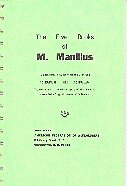
THE FIVE BOOKS OF M. MANILIUS, containing a system of ancient astronomy & astrology together with the philosophy of the Stoicks - Manilius, translated by Thomas Creech, $11.00
Contents:

Preface to this edition, by Ernest Grant, 1953 (founder & head of the AFA)
An account of Manilius

The Five Books

Comment: This is poetry translated as poetry, which is a difficult & thankless job (I can read French, and English translations of French poetry simply do not work). By the time this translation was first published, in 1697, there was an abundant trade in English prose books (Christian Astrology having appeared some 50 years earlier), so there is no clear reason why Thomas Creech should have written poetry rather than prose, aside from his personal taste in the matter.

In addition to being poetry, and in addition to its wire binding, the text is set in an annoying typewriter font, which on a few pages is a bit light. If there are any advantages to this, over the Loeb edition (aside from price), it is that astrological terms, such as square & trine, are accurately rendered. This is not a significant advantage, in my view.

See above for an extended listing of the contents.

AFA, spiral bound, 179 pages.


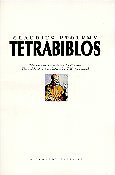
TETRABIBLOS - Claudius Ptolemy, translated by J.M. Ashmand, $19.95
The famous 1822 translation by J.M. Ashmand. The cornerstone of western astrology, Ptolemy's Tetrabiblos is the source of many of the concepts that still guide astrology.

Contents:

Book 1: 1. Proem; 2. Knowledge may be acquired by astronomy to a certain extent; 3. That prescience is useful; 4. The influences of the planetary orbs; 5. Benefics and malefics; 6. Masculine and feminine; 7. Diurnal & nocturnal; 8. The influence of position with regard to the sun; 9. The influence of the fixed stars; 10. Constellations north of the zodiac;

11. Constellations south of the zodiac; 12. The annual seasons; 13. The influence of the four angles; 14. Tropical, equinoctial, fixed & bicorporeal signs; 15. Masculine & feminine signs; 16. Mutual configurations of the signs; 17. Signs commanding & obeying; 18. Signs beholding each other and of equal power; 19. Signs inconjunct; 20. Houses of the planets;

21. Triplicities; 22. Exaltations; 23. Disposition of the terms; 24. The terms (according to Ptolemy); 25. The places & degrees of every planet; 26. Faces, chariots and other attributes of the planets; 27. Application, separation & other faculties.

Book 2: 1. General division of the subject; 2. Peculiarities observable throughout every climate; 3. The familiarity of the regions of the Earth with the triplicities & the planets; 4. The familiarity of the regions of the earth with the fixed stars; 5. Mode of particular prediction in eclipses; 6. The regions or countries to be considered as liable to be comprehended in the event; 7. The time & period of the event; 8. The genus, class, or kind liable to be affected; 9. The quality & nature of the effect; 10. Colours in eclipses, comets, and similar phenomena; 11. The new moon of the year; 12. The particular natures of the signs by which the different constitutions of the atmosphere are produced; 13. Mode of consideration for particular constitutions of the atmosphere; 14. The signification of meteors.

Book 3: 1. Proem; 2. The conception & the parturition, or birth, by which later even the animal quits the womb & assumes another state of existence; 3. The degree ascending; 4. Distribution of the doctrine of nativities; 5. Parents; 6. Brothers & sisters; 7. Male or female; 8. Twins; 9. Monstrous or defective births; 10. Children not reared;

ll. The duration of life; 12. The prorogatory places; 13. The number of prorogators, and also the Part of Fortune; 14. Number of the modes of prorogation; 15. Exemplifaction; 16. The form and temperament of the body; 17. The hurts, injuries & diseases of the body; 18. The quality of the mind; 19. The diseases of the mind.

Book 4: 1. Proem; 2. The fortune of wealth; 3. The fortune of rank; 4. The quality of employment; 5. Marriage; 6. Children; 7. Friends and enemies, 8. Travelling; 9. The kind of death; 10. The periodical divisions of time.

Appendices: Extracts from the Amalgest; The complete Centiloquy; The zodiacal planisphere.

Comment: Ashmand's translation is superior to that by F.E. Robbins in one critical respect: Ashmand was an astrologer & well-understood what he translated, the result shows - on every page. Every important astrologer in the last 2 millennia has studied this book, every major astrologer of the last two centuries has poured over these very words. Join with them, join in the continuing astrological renewal of the last ten years.

Click here for an excerpt (pdf).

164 pages with footnotes throughout. Astrology Classics, paper.


TETRABIBLOS - Ptolemy, translated by F.E. Robbins, $28.00 First published in 1940

Contents:

Introduction
The luminaries & planets
The signs of the zodiac

Book One:
1. Introduction
2. That knowledge by astronomical means is attainable, and how far
3. That it is also beneficial
4. Of the power of the planets
5. Of beneficent & maleficent planets
6. Of masculine & feminine planets
7. Of diurnal & nocturnal planets
8. Of the power of the aspects to the Sun
9. Of the power of the fixed stars
10. Of the effects of the seasons & of the four angles
11. Of solistial, equinoctial, solid & bicorporeal signs
12. Of masculine & feminine signs
13. Of the aspects of the signs
14. Of commanding & obeying signs
15. Of signs which behold each other & signs of equal power
16. Of disjunct signs
17. Of the houses of the several planets
18. Of the triangles
19. Of exaltations
20. Of the disposition of terms
21. According to the Chaldeans
22. Of places & degrees
23. Of faces, chariots & the like
24. Of applications & separations & the other powers

Book Two:
Introduction
2. Of the characteristics of the inhabitants of the general climes
3. Of the familiarities between countries & the triplicities & stars
4. Method of making particular predictions
5. Of the examination of the countries affected
6. Of the time of the predicted events
7. Of the class of those afflicted
8. Of the quality ofhte predicted event
9. Of the colours of eclipses, comets & the like
10. Concerning the new moon of the year
11. Of the nature of the signs, part by part, and their effect upon the weather
12. Of the investigation of weather in detail
13. Of the significance of atmospheric signs

Book Three:
1. Introduction
2. Of the degree of the horoscopic point
3. The subdivision of the science of nativities
4. Of parents
5. Of brothers & sisters
6. Of males & females
7. Of twins
8. Of monsters
9. Of children that are not reared
10. Of length of life
11. Of bodily form & temperament
12. Of bodily injuries & diseases
13. Of the quality of the soul
14. Of diseases of the soul

Book Four:
1. Introduction
2. Of material fortune
3. Of the fortune of dignity
4. Of the quality of action
5. Of marriage
6. Of children
7. Of friends & enemies
8. Of foreign travel
9. Of the quality of death
10. Of the division of times

Index

Comment: Ashmand is the better translator, as he well-knows who will be reading his text & what they will expect. Robbins has the better source materials, but does not handle them as well. Both these translations are good, but there remains a slight advantage to Ashmand.

The Loeb edition lacks the Centiloquy, which, while customarily appended to the Tetrabiblos, is by other hands.

Loeb Classical Library. Hardcover, 466 pages.


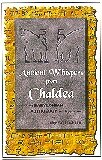
ANCIENT WHISPERS FROM CHALDEA, Making Babylonian Astrology work for You - Arthyr W. Chadbourne, $19.95
Contents: Introduction;
Part 1: 1. Intelligenesis; 2. Initial basics; 3. The Sun; 4. The Moon; 5. The planets; 6. Exalted strength; 7. The lunar nodes; 8. Chaldean sunset system; 9. Chart interpretation; 10. The solar return; 11. The horary chart; 12. Harmonics

Part 2: History: Overview; 13. Chaldean astrology; 14. Egyptian cosmology;

Bibliography; Index.

Comment: First printed in 1999 (a long time ago), there were two things about this book that initially put me off: Only available from an obscure printer, and well-meaning but off-putting hype, such as, The most innovative astrology in 1,700 years!.... The astrological upgrade for the new millennium (both from the back cover).

This is, in fact, as serious & as scholarly a book as can be found outside academia. I do not know where Chadbourne gets his "stuff", but reading the opening pages closely, it's clear he has a good grasp of the relevant materials. From the Chaldeans we get time itself: The seven day week, the 24 hour day, the 60 minute hour, and, by extension, the daily & planetary rulers, and from that, not only astrology, but magic as well.

Chadbourne tells us the differences between Chaldean, Greek & Egyptian cultures, to wit, the Chaldeans were inventors & innovators, the Greeks eager students & proselytizers. The Egyptian civilization, by contrast, emphasized The Now (aka the Nile), which made astrology redundant. Of the three, Egyptians knew best how to run a library, which gives us Alexandria.

Chaldean astrological innovations include what eventually became known as Primary Directions, as well as the sunset chart, lunar mansions, exaltations, nodes & more. The uses Chadbourne makes of these, the ways in which he brings them into the modern world, will surprise you.

Intelligenesis Publications, 510 pages.


MYSTICAL ASTROLOGY ACCORDING TO IBN 'ARABI - Titus Burckhardt, $9.00
Contents: Foreward by Keith Critchlow, 5 untitled chapters. Concludes with 12 pages of illustrations, similar to that on the cover. They are from the 16th century Persian manuscript, Suwar al-Kawakih of al-Sufi (The Shape of the Stars), which was written by the Persian astronomer, Abd al-Rahman al-Sufi in about 960 AD. This, in its turn, was based on Ptolemy's Almagest.

Comment: From the foreword: As the term Astrology means the practical application of astronomy to human use, our response to it must necessarily hinge on our understanding of what it means to be human. What is that 'favorable moment' which the Buddha urges us to grasp? Why does he congratulate those who 'have seized their moment' and lament those 'for whom the moment is passed'? The explanation lies in the traditional view of time.

Of the author, the inside front cover says, An eminent Swiss metaphysician & scholar of oriental languages Titus Bruckhardt (1908-1984) devoted his life to the timeless and universal wisdom present in Sufism, Vedanta, Taoism, Platonism, and the other great esoteric & sapiential traditions. Though an art historian like his great uncle the renowned Jacob Bruckhardt, his main interest was the spiritual use & meaning to be found in Eastern & Western art & architecture, and the expression of the sacred in the lives of saints.

Fons Vitae, 64 pages.


The Astrology Center of America

207 Victory Lane, Bel Air, MD 21014
Tel: 410-638-7761; Fax:410-638-5154; Toll-free (orders only): 800-475-2272

Home Author Index Title Index Subject Index Vedic Books Tarot E-Mail: Dave


Established 1993, The Astrology Center of America is owned & operated by David Roell.
This entire site (AstroAmerica.com) is copyright 1996, 1997, 1998, 1999, 2000 by William R. Roell. All rights reserved.