The Astrology Center of America, 207 Victory Lane, Bel Air, MD 21014
Tel: 410-638-7761; Toll-free (orders only): 800-475-2272
Home Author Index Title Index Subject Index Vedic Books Tarot E-Mail: Dave


Astrology and Psychology: Counseling Astrology, page 3


Counseling Astrology: Page 1 Page 2 Page 3

See also: Liz Green, Howard Sasportas & Friends
and: Donna Cunningham


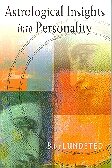
ASTROLOGICAL INSIGHTS INTO PERSONALITY - Betty Lundsted, $19.95
Contents: Introduction; 1. The basics: Mommy, daddy & the kid, Symbolism & the wheel, Polarities, Modes & elements, The astrological signs; 2. Planets & aspects: Introduction, Sun aspects, Moon aspects, Mercury aspects, Venus aspects, Mars aspects, Jupiter aspects, Saturn aspects, Uranus aspects, Neptune aspects, Pluto aspects, The ascendant & its aspects; 3. Examples: Beginning diagnosis, A female chart, A male chart; Bibliography.

Comment: Betty Lundsted (died 2001) was the wife of Donald Weiser, who was the founder of Weiser Books, in Maine. This book was first published in 1980, went out of print around 2000, and is now available again. Lundsted was known for her insights & no-nonsensee delivery, but, as I read my chart in her book, my opinion is she wanders from keen insights to ungrounded theory without seeming to know the difference. The writing is intense & very much to the point. In this book is everything your chart can tell you about your parents & what they mean in your life. As this is the earliest book of this genre that I know of, it would seem to have had a seminal impact on later authors.

Ibis Press, 352 pages.


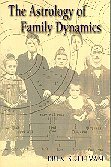
ASTROLOGY OF FAMILY DYNAMICS - Erin Sullivan, $28.95
Contents: Introduction;

Part 1: The Big Picture: The organic family: 1. The individual & the collective; 2. The nuclear family as a system; 3. Family patterns & family trees; 4. The sun & moon in families; 5. Mothers & fathers: Freud had it half right; 6. Family themes: movers & shakers in the family; 7. Families & our familiars;

Part 2: Family Dynamics: 8. The modal family: the tension of life; 9. The elemental family: circuits of being; 10. The water houses: the ancestral eyes of the soul; 11. Families in flux: transits & moving forward;

Part 3: Dynasty: 12. Real lives, real people; 13. Tobias: touched by God; 14. Mohsin: who am I?; 15. Rejected in the womb; 16. What's bred in the bone: the circuit breaker; 17. The procession of the ancestors; 18. The last in line: the many in the one.

Appendices: The Kennedy family; Over-development in a sign. Bibliography; Index.

Comment: Previously published as Dynasty, the Astrology of Family Dynamics. Like no other system of psychological theory, astrology illuminates the complexities of the family as an organic whole, as well as its place in society. Five family case studies demonstrate the varieties of family dynamics. Why can’t a sibling get along, why a child looks like an ancestor, much more revealed & explained. A unique book.

Weiser, 401 pages.


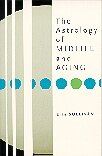
THE ASTROLOGY OF MIDLIFE & AGING - Erin Sullivan, $15.95
Contents: Introduction: The great journey of life;

Part 1: A meeting at the crossroads. 1. Meeting life halfway; 2. Three stages of midlife transition; 3. The significance of Saturn & Uranus in midlife transition; 4. Uranus by sign as a midlife purpose indicator; 5. The half-Uranus house: the unlived life; 6. Generational impulse: purpose & vision in creating the future; 7. A meeting at the crossroads; 8. Middlescence; 9. Age 50: the watershed & the Chiron return.

Part 2: Beyond the bounds of Saturn. 10. Introduction to aging; 11. Sans eyes, sans teeth, sans everything?; 12. The third act; 13. The path untrodden.

Acknowledgements; Recommended reading & source materials; Index.

Comment: The two main thrusts to this book are the Uranian opposition that happens around age 39 (aka midlife crisis), and the second Saturn return at around age 58. To this simple formula, Sullivan throws in everything she can find: The 3rd Jupiter return, the second nodal return, Saturn trining itself, Neptune squaring itself, inverted nodes, another Jupiter return, the Chiron return, Saturn square itself, the second progressed lunar return, etc. Sullivan relies heavily on Joseph Campbell & myth, as well as various psychological examinations of midlife & aging. For those of you who like this sort of thing, that should be enough.

Jeremy P. Tarcher/Penguin, 232 pages.


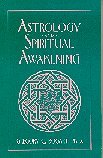
ASTROLOGY & SPIRITUAL AWAKENING - Greg Bogart, $19.95
Contents:

About the author
Acknowledgments
Foreward, by Shelley Jordan
Introduction

Part 1: Astrology & spiritual awakening:
1. Astrological symbols & the birth chart
2. Finding a spiritual path: The twelve yogas of the zodiac

Part 2: Transpersonal astrology & the path of transformation:
3. From predictive to humanistic astrology
4. The transpersonal level of chart interpretation
5. The six Shaktis

Part 3: Astrological biographies of spiritual teachers:
6. An astrological biography of Meher Baba
7. An astrological biography of Bhagwan Rajneesh (Osho)
8. An astrological biography of Mircea Eliade
9. An astrological biography of Swami Muktananda
10. An astrological biography of Sri Kriyananda
11. An astrological biography of Rabindranath Tagore
12. An astrological biography of Ram Dass

Conclusion: writing your own astrological biography
References
Index

Comment: Inspired by Rudhyar. This book links planets, signs & houses, as is customary with these authors, in order to arrive at one of twelve possible spiritual paths, based on the twelve signs of the zodiac. To this, Bogart adds Rudhyar's six Shaktis, or faculties. They are: Physical & emotional purification, knowledge, will, creativity, action, and self-consecration. Each of the biographies includes the natal chart.

Dawn Mountain Press, 243 pages.


FIRST SURVIVE, THEN THRIVE, The Journey from Crisis to Transformation - John Eddington & Beth Rosato, $18.95
Contents:

Preface
Introduction

Part 1: The stages of crisis, management & transformation:
Awareness of crisis: The solar stage
Self-acceptance & adjustment: The lunar stage
Problem solving: The Mercury stage
Support: The Venus stage
Implementation: The Mars stage
Personal maintenance: The Jupiter stage
Evaluation: The Saturn stage
Closure: The Uranus, Neptune & Pluto stage

Part 2: How do you problem solve? An in-depth look at the astrological signs:
Personalizing the astrology
Aries in crisis
Taurus in crisis
Gemini in crisis
Cancer in crisis
Leo in crisis
Virgo in crisis
Libra in crisis
Scorpio in crisis
Sagittarius in crisis
Capricorn in crisis
Aquarius in crisis
Pisces in crisis

Reviewing the journey
Postscript

Comment: A team of counseling social worker (Eddington) & trained astrologer (Rosato, the former Beth Koch) offer help for those in crisis. How well does this work?

Okay, you're in crisis (we've all been there). Stage four, the Venus phase, are all the new people you will meet. Myself, I can't recall that happens in the crisis state, but the authors say you can if you reach out. Some of the people you can meet are "Chicken soup people," who offer support; "Fun & adventure people," who will make you laugh; "Intellectual people," who give you helpful books & magaziznes; "Models & mentors," which you have to search for; "Total positive regard people," who accept you just as you are (mom, anyone?); and, "Confidante," someone who simply listens. The trick with confidantes is learning how to talk to one. Nowhere in this list are the all-too-common human parasites that people in crisis often have to put up with. Presumably they're nothing new.

So, in crisis, Aries tend to fight their way out, Taureans try to prove they're superior, Geminis, for some unknown reason, are asked to get in touch with their feelings, when there are far more "Geminian" ways of going about things, Cancers try to avoid their feelings (are Cancer & Gemini opposites?), etc. As for which of the twelve that's "right" for you, it might be your sun sign, it might be your moon sign, it might be the sign of the ruler of the ascendant, or it might be some other sign. Since most if not all crisis have progressed or transiting factors behind them, the sign of the afflicting planet may be a starting point.

AFA, 210 pages.


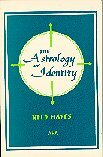
THE ASTROLOGY OF IDENTITY - Reed Hayes, $20.95
Contents:

Dedication
Acknowledgements
Introduction

1. Question of identity: Who am I?
2. Karmic identity: There are no accidents
3. Hidden identity
4. Androgyny: Dispelling the male-female myth
5. Sun, symbol of individualism
6. Search for emotional security
7. Importance of human interchange
8. Venus, planet of value orientation
9. Mars, thrust of life
10. Jupiter, hunger for social nourishment
11. Reality of Saturn
12. Beyond the boundaries of ego
13. Spiritual identity urges
14. Pluto's power potential
15. Cycles of transformation: Urges toward identity alteration
16. Creativity, a product of the search for identity

Appendices:
A. Planets
B. Aspects
C. Houses
D. Planetary rulerships of signs & houses

Bibliography

Comment: The underlying reason for this book is puzzling to me. So, from the first chapter:

It is easy to discern the identity or unity of fictitious characters. We read in printed form just who the character is. We understand his thoughts & actions by what the writer tells us about him. He is a clearly defined individual whose personality is bound by the author's creation.

In everyday life a different situation exists. As human beings we are not clearly defined. While we can look back on the past & make certain observations & judgments about ourselves, we are never quite certain about the origin of all our many thoughts & feelings. There is a constant movement (albeit interspersed with crisis) from past to future, each new circumstance creating a new layer of relatedness, a new addition to the entire map of the psyche. There is always a certain mystery or wonder about who we really are, as a result of these innumerable layers of experience that become obscured by one another. (pg. 3)

The central part of this book are planet-by-planet aspect delineations. Sun conjunct Moon, Sun sextile Venus, Moon opposed Pluto, etc., etc. So it would seem that your identity is the same as knowing your astrological chart.

AFA, 267 pages.


JUNG & ASTROLOGY - Maggie Hyde, $19.95
Contents:

Dedication
Acknowledgments
Introduction

1. The age of the fishes
2. Jung, Freud & the occult
3. Lands of darkness
4. Jung sings: The symbolic attitude
5. Psychological astrology: The search for deep meaning
6. The map of the psyche
7. Synchronicity
8. Astrology at work: Interpreting coincidence
9. Stretching the heavens abroad
10. The secret mutual connivance
11. The astrologer's universe: An alchemical image

Appendices:
1. Uranus-Neptune transits
2. Mars-Jupiter-Saturn: Jung & Freud
3. Freud's time twin
4. The astrology of Chiwantopel
5. Puer B: An amalgam
6. A final trick

The Company of Astrologers
Notes
Index

Comment: From the back of the book:

The depth psychology of Carl Jung has been a formative influence in the growth of 20th century astrology. There are few modern astrology books which do not somewhere rely on, quote or misquote a concept that comes directly from Jung. Guided by the symbols in Jung's own horoscope, this book describes Jung's awakening to the power of astrological symbolism

But Jung struggled with unresolved dilemmas about the conceptual foundation of astrology. His model of the psyche has been simplistically adopted by modern "psychological astrology", yet important questions that he raised about the symbolic attitude have been ignored. Using many lively examples, the concepts of "synchronicity" & the "secret mutual connivance" are for the first time analysed & demonstrated with respect to their radical implications for the whole practice of astrology.

Astrology & the occult were more fundamental to Jung's work than is commonly realized. In this controversial book, Maggie Hyde answers a need to reassess both astrology's contribution to Jungian psychology & Jung's impact on the modern practice of astrology.

If it's of interest, the work of Liz Greene is one of the principle examples used in this book.

Aquarian, 256 pages.


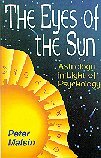
THE EYES OF THE SUN: Astrology in Light of Psychology - Peter Malsin, $16.95
Contents:

Acknowledgements
Introduction

Part 1:
1. Astrology, the psyche & science
2. The nature of the beast
3. The Jungian blueprint
4. The evolution of basic instincts
5. On the fringes of science
6. Experimental research: The wild frontier
7. The politics of astrological experience from Plato to Pluto

Part 2:
The system & structure of astrological symbolism
The twelve astrological principles:

  • The first principle: Aries/Pluto
  • The second principle: Taurus/Earth
  • The third principle: Gemini/Asteroids
  • The fourth principle: Cancer/the Moon
  • The fifth principle: Leo/the Sun
  • The sixth principle: Virgo/Mercury
  • The seventh principle: Libra/Venus
  • The eighth principle: Scorpio/Mars
  • The ninth principle: Sagittarius/Jupiter
  • The tenth principle: Capricorn/Saturn
  • The eleventh principle: Aquarius/Uranus
  • The twelfth principle: Pisces/Neptune

Part 3:
10. Ghosts in the machine
11. Psychological theory for lunatics
12. Myths of Cancer, scorpions & the new age
13. Spiritual dimensions of astrology

Part 4:
14. Interpretation, take one: A Saturnian format
15. Interpretation, take two: Psychological approaches
16. Retrograde planets
17. Planets R Us

Appendices:
1. Moon signs, emotional predispositions & patterns of childhood experience
2. The goddess asteroids & Chiron
3. Notes on the natal chart
4. Radically rethinking rulerships

References
About the author

Comment: For Peter Maslin, the world changed in 1971, when, fresh out of college (age 22), he was driving the 101 north of San Francisco & picked up two hitchhikers. Turns out that one of them shared the same day, month & year of birth as Maslin, and that the day in question was their 22nd birthday. The two got on famously, which is to say, that the date in question, August 17, 1949, Sun in Leo, Moon in Gemini, produced people who basically liked themselves.

As the subtitle suggests, this is a book that blends astrology & Jungian psychology. As the table of contents suggests, it has a primary focus on the twelve signs of the zodiac.

In the back Maslin gives delineations of the natal moon through the 12 signs of the zodiac. For a Gemini moon, we read the usual story that Geminis need to get in touch with their feelings. I usually presume this holier than thou attitude comes from those with no idea what Gemini is, but in this case, Maslin has his moon firmly in Gemini & so should know. Gemini, late in the 6th. Dispositor Mercury in Virgo in the 9th, sandwiched between Saturn & Venus, both in Virgo, and both in the 9th. This is, in my judgement, not a happy house placement for these three, nor for Virgo. Mercury in Virgo is detail, Saturn in Virgo says no to detail, and the 9th house says, who cares about details anyway? It's been my observation that people with challenges like this use them to write books like this. Which is rich in studious details.

I should really stop teasing my poor customers & write a book on how to read a chart using dispositors & their house values. You haven't really read a chart until you've seen what dispositors & houses can do, but I digress.

New Falcon Publications, 347 pages.


Counseling Astrology: Page 1 Page 2 Page 3

See also: Liz Green, Howard Sasportas & Friends
and: Donna Cunningham


The Astrology Center of America

207 Victory Lane, Bel Air, MD 21014
Tel: 410-638-7761; Toll-free (orders only): 800-475-2272

Home Author Index Title Index Subject Index Vedic Books Tarot E-Mail: Dave


Established 1993, The Astrology Center of America is owned & operated by David Roell.
This entire site (AstroAmerica.com) is copyright 1996, 1997, 1998, 1999, 2000 by William R. Roell.
All rights reserved.